Author: Tyler

  • How Much Protein Do Men Over 40 Need?

    How Much Protein Do Men Over 40 Need?

    Medical disclaimer: This article is for educational purposes only and is not medical advice. It does not replace guidance from your doctor or a registered dietitian. Talk to your doctor before raising your protein intake — especially if you have kidney disease, diabetes, liver disease, or any other ongoing health condition.

    If you are over 40 and trying to hold on to muscle — or lose fat without losing the muscle you have — protein is the part of your diet worth getting right first. Not perfect. Just right enough, most days.

    The official minimum is lower than what is commonly recommended for active older men. The useful answer depends on your body weight and activity level. This guide covers the numbers, what they look like at three common weights, how to split them across meals, and how to hit them with normal food.

    The quick answer

    For a generally healthy man over 40:

    • The floor: 0.8 grams of protein per kilogram of body weight per day (0.8 g/kg/day). That is the Recommended Dietary Allowance (RDA) — a minimum to prevent deficiency, not a muscle-preservation target.
    • Active men: Sports-nutrition guidance commonly recommends roughly 1.2 to 1.6 g/kg/day for active and older men.
    • Hard training or dieting: Guidance ranges in the sports-nutrition literature go up to around 2.2 g/kg/day.

    These higher ranges are attributed generally to position stands from organisations such as the International Society of Sports Nutrition. They are guidance ranges, not guarantees — and more is not automatically better.

    What the RDA actually means

    The RDA for protein for adults is 0.8 g/kg/day, as referenced by the National Institutes of Health (NIH) and the Dietary Guidelines framework — about 0.36 grams per pound.

    The point most articles miss: the RDA was set to cover the minimum needed to prevent deficiency in most healthy adults. It was not set as the ideal intake for a man in his forties who trains and wants to keep his muscle as he ages.

    That makes it a floor, not a target. If you are below it, reaching it is a sensible first step. If you train, aiming only for the floor is likely aiming too low, based on the higher ranges commonly recommended for active and older adults.

    Why this matters more after 40

    Keeping muscle after 40 takes more deliberate effort than it did at 25. Training provides the stimulus; protein provides the raw material your body uses to repair and maintain muscle tissue.

    During fat loss, a higher intake within the ranges above is commonly recommended to help protect lean tissue when calories are lower. Protein-rich meals also tend to keep people full longer, making a sensible eating pattern easier to stick to. Protein is one important lever — not a shortcut, and not a substitute for training, sleep, or appropriate calories.

    How much for your body weight?

    Most men think in pounds, so the table converts the ranges (1 kilogram = approximately 2.2 pounds).

    Body weightWeight in kgRDA floor: 0.8 g/kgActive range: 1.2–1.6 g/kgUpper guidance: up to 2.2 g/kg
    170 lbapprox. 77 kgapprox. 62 g/dayapprox. 93–123 g/dayapprox. 170 g/day
    200 lbapprox. 91 kgapprox. 73 g/dayapprox. 109–145 g/dayapprox. 200 g/day
    230 lbapprox. 104 kgapprox. 83 g/dayapprox. 125–167 g/dayapprox. 230 g/day

    Read it by activity, not ambition. A 200 lb man who is mostly sedentary sits nearer the left. A 200 lb man who trains several times a week and is losing fat will usually aim for the middle — roughly 109 to 145 grams a day.

    You do not need the upper figure to make progress; it shows the full range discussed in the literature. Consistently hitting the middle range beats hitting a very high number occasionally. Judge a change after a few weeks by adherence, hunger, strength, and recovery — there is no honest week-by-week timeline for muscle change.

    How to split protein across the day

    The daily total matters most, but spreading protein across meals makes that total easier to reach without one huge meal doing all the work.

    A commonly used approach in sports-nutrition guidance is roughly 25 to 40 grams of protein per meal, across 3 to 4 meals a day. Three meals at around 35–45 grams each cover the middle range for many men; three meals plus a protein-rich snack works if you prefer smaller meals.

    Breakfast is where most men fall short — toast, cereal, or juice alone leaves you playing catch-up all day. Treat this as structure, not a strict rule: a pattern you will keep beats a perfect one you will abandon.

    Best whole-food sources

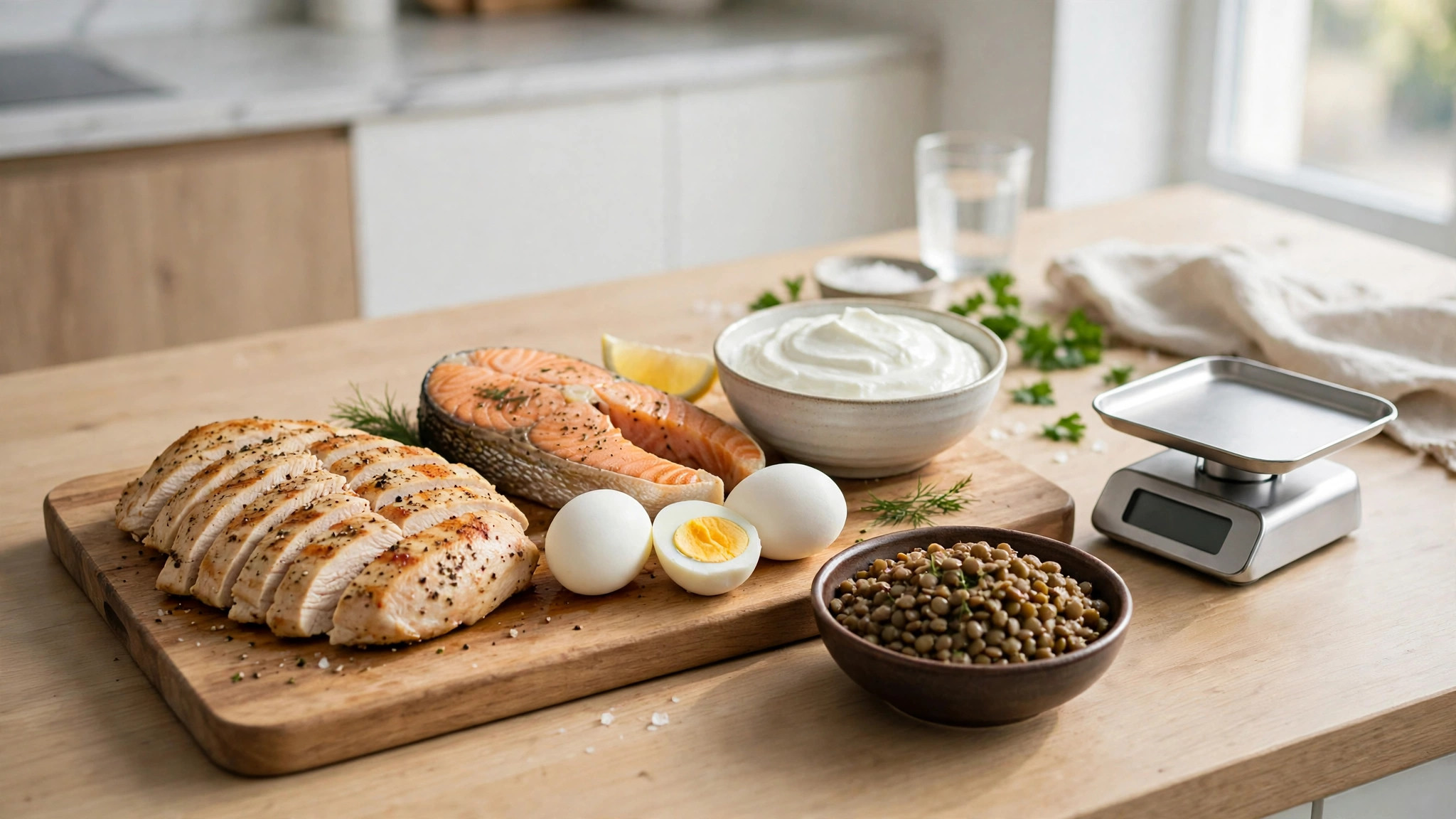
    Food first — your base should be meals you enjoy and can repeat. The values below are approximate, from standard nutrition references. Use them for planning, not as exact figures, and check labels where you have them.

    FoodTypical servingProtein (approx.)
    Chicken breast, cooked3.5 oz (approx. 100 g)approx. 31 g
    Lean beef, cooked3.5 oz (approx. 100 g)approx. 26 g
    Salmon, cooked3.5 oz (approx. 100 g)approx. 22–25 g
    Greek yogurt, plain1 container (approx. 170 g)approx. 17 g
    Lentils, cooked1 cupapprox. 18 g
    Cottage cheese1/2 cupapprox. 14 g
    Milk1 cupapprox. 8 g
    Eggs1 large eggapprox. 6 g
    Tofu, firm3.5 oz (approx. 100 g)approx. 8–10 g

    Anchor each meal around one clear protein source, then add vegetables, grains, fruit, or fats to meet your calorie needs. Note the egg maths: at approximately 6 grams each, two eggs give about 12 grams — not a high-protein breakfast alone. Pair them with Greek yogurt or cottage cheese to reach the per-meal range.

    Protein powder: convenience, not a requirement

    Protein powder is not required. Every range above can be met from whole foods, as the table shows. Powder is simply convenient when you are short on time, travelling, or consistently falling short from meals. If you use one, check the label for protein per serving, calories, and added sugar. It fills a gap; it does not change the targets.

    Amino acid supplements — the short version

    Protein from food already provides the amino acids your body needs, including the essential ones it cannot make. Total daily intake is the subject here; isolated amino acid products are not covered.

    That separate topic is covered in our BCAA/EAA article, and supplements more broadly in our Best Supplements for Men Over 40 guide. Fix your total protein first.

    Kidney and health cautions

    Do not raise your protein intake casually if your health is not straightforward.

    Men with kidney disease, diabetes, liver disease, a history of kidney stones, or any condition where a doctor has advised limiting protein should get medical guidance before increasing their intake. The same applies if you take medication or have blood work your doctor is monitoring.

    This article makes no claim that any particular intake is safe for everyone. The ranges here are general guidance for generally healthy adults, not a personal recommendation for you. If you have been told your kidney function is reduced, or you notice swelling or major changes in urination, talk to your doctor promptly.

    If you are generally healthy and moving up from a low intake, do it gradually, from whole foods first — and if in doubt, ask your doctor or a registered dietitian.

    A simple way to start

    1. Estimate where you are now. Track two or three normal days honestly — most men overestimate their protein until they write it down.
    2. Pick your range from the table for your weight and activity, starting at the modest end if you are well below it.
    3. Fix breakfast first. Add one clear protein source you will actually eat.
    4. Anchor lunch and dinner around a protein food, adjusting portions to your per-meal aim.
    5. Review after a few weeks — adherence, hunger, training, how you feel.

    FAQ

    Is 100 grams of protein a day enough for a man over 40?

    It depends on your weight and activity. For a 170 lb man, 100 grams sits inside the active range of approximately 93 to 123 grams. For a 230 lb man who trains, it is above his RDA floor of approximately 83 grams but below his active range of approximately 125 to 167 grams.

    Should I count per pound instead of per kilogram?

    You can. The RDA of 0.8 g/kg equals about 0.36 g per pound; the active range of 1.2 to 1.6 g/kg equals roughly 0.55 to 0.73 g per pound. Guidelines use kilograms, which is why this article leads with them.

    Is a higher protein intake bad for healthy kidneys?

    This article makes no absolute safety claims for any intake. Men with kidney disease or related conditions should not raise their intake without medical guidance. If you are unsure about your kidney health, ask your doctor first.

    Can I get enough protein without eating meat?

    Yes, with planning. Eggs and dairy provide substantial protein if you eat them. Plant sources such as lentils (approximately 18 grams per cooked cup), tofu, and beans contribute too, but portions tend to provide less than meat or fish, so be deliberate about amounts and variety.

    Does meal timing around training matter?

    For most men, the daily total and consistency come first. A normal protein-containing meal before or after training is practical, and splitting intake into roughly 25 to 40 gram meals helps many men reach their total.

    Conclusion

    Start from the floor — 0.8 g/kg/day, attributed to the NIH and Dietary Guidelines framework — and recognise it as a deficiency-prevention minimum. If you are active, the ranges commonly recommended in sports-nutrition literature, roughly 1.2 to 1.6 g/kg and up to around 2.2 g/kg for hard training, are the more relevant map.

    Pick the range that fits your weight and training, spread it across meals you can repeat, and build it from whole foods. (The training side is covered separately in our build-muscle article.) Get medical advice first if kidney disease, diabetes, or any other condition applies.

    Get the basics right, consistently. That is the unglamorous answer — and the one that holds up.

  • How to Increase Testosterone Naturally After 40

    How to Increase Testosterone Naturally After 40

    Man in his late 40s training with a dumbbell in a home gym

    Testosterone plays a central role in a man’s strength, energy, and sex drive. According to Mayo Clinic, testosterone levels begin to gradually decline after age 40. That decline is normal — feeling run down and unlike yourself does not have to be.

    This article is the action plan: what you actually do, day to day, to support healthy testosterone levels. It is not a symptoms checklist — if you are asking whether your symptoms could be low testosterone, read our low testosterone symptoms guide and then get tested. Nor is it a food list. It covers the lifestyle levers you control, what to skip, and when a doctor needs to be involved.

    Medical disclaimer: This article is for education only and is not medical advice. Low testosterone is diagnosed by repeated morning blood tests, not by symptoms alone. If you think you may have low testosterone, see a doctor and get tested rather than trying to treat yourself. Testosterone replacement therapy is a medical decision with real risks and monitoring requirements.

    1. Train With Resistance, and Move Every Day

    Resistance training sits at the top of this list. Mayo Clinic’s guidance on lifestyle and testosterone puts regular exercise, including strength training, at the centre of what men can control. Lifting weights, using resistance bands, or doing bodyweight training gives your body a reason to maintain muscle — and muscle is tied to strength, metabolism, and how capable you feel as you age.

    A practical approach for a man over 40:

    • Two to four resistance sessions a week, covering the major muscle groups.
    • Compound movements first — squats or leg presses, rows, presses, deadlift variations — scaled to your joints and experience.
    • Progressive effort: slightly more weight, more repetitions, or better control than last week.
    • Daily walking on top of training — underrated, free, and easy on the joints.

    Cardio still matters for heart health and weight control, and the two work better together than either alone. Consistency beats intensity: a moderate programme you follow all year does more than an extreme one you quit in a month with sore knees. Train hard enough to challenge yourself, and recover properly between sessions.

    2. Lose Belly Fat if You Are Carrying It

    Excess body fat, especially around the waist, works against testosterone directly. Fat tissue contains an enzyme called aromatase, which converts some testosterone into oestrogen. In plain language: the more belly fat a man carries, the more of his testosterone gets converted into a different hormone. Losing fat removes part of that conversion pressure.

    Crash diets are a poor answer. Severe calorie restriction and rapid weight loss often cost muscle as well as fat, and leave you feeling worse. Aim instead for steady, sustainable fat loss built on the habits in this article: training, enough food to support it, good sleep, and less alcohol. Treat weight as a long game — you are changing the environment your hormones operate in, and that environment changes gradually, with your habits.

    3. Fix Your Sleep Before You Buy Anything

    Testosterone is produced largely during sleep, so short nights and broken sleep work against you night after night. Untreated sleep apnoea matters here too: it is common in men over 40, fragments sleep all night, and no supplement will fix it. If you snore heavily, wake unrefreshed, or your partner notices pauses in your breathing, raise it with your doctor.

    Build the basics first:

    • Keep regular sleep and wake times, including at weekends.
    • Keep the bedroom dark, cool, and quiet; keep screens out of the last part of the evening where you can.
    • Cut caffeine earlier in the day if you are sensitive to it.
    • Never use alcohol as a nightcap — it may help you fall asleep, but it worsens sleep quality.

    If tiredness is your main problem, it has many causes beyond testosterone — our article on why you are tired all the time works through the wider picture.

    4. Get Stress Under Control

    Under sustained pressure, your body produces more cortisol, the main stress hormone. Cortisol and testosterone pull in opposite directions: a body constantly in stress mode is prioritising survival, not muscle, sex drive, or recovery. Long hours, money worries, family pressure, and poor sleep stack together, which is why stress and sleep are best treated as one problem, not two.

    What helps is unglamorous: the regular exercise you are already doing, daylight and time outside during the day, a real stopping point to the working day where your situation allows it, and not carrying every problem alone. Persistent low mood, anxiety, or stress that does not lift deserves a conversation with a doctor, not just willpower. And be honest about load — if your week is permanently overloaded, no supplement fixes that. Reducing the load, where you can, is a health intervention in itself.

    5. Eat Well, and Correct Genuine Deficiencies

    Food itself gets one short paragraph here, deliberately: base your meals on whole foods, eat enough protein to support training, include healthy fats, and do not chronically under-eat — a man who trains while under-fuelled sends his body the opposite signal to the one he wants. For specific foods and meal ideas, see our testosterone-foods guide, which covers that ground in full.

    The part that belongs in this action plan is deficiencies. Vitamin D, zinc, and magnesium come up repeatedly in this conversation, and the honest framing matters: if you are genuinely deficient in a nutrient, correcting that deficiency supports normal hormone production. If you are not deficient, taking more does not push testosterone above its normal range — a supplement tops up a gap; it does not act like a drug. So test rather than guess, supplement only a known gap at sensible doses, and use our Best Supplements for Men Over 40 guide to judge any product before spending money on it.

    6. Cut Back on Alcohol

    Alcohol works against testosterone through several routes at once: it interferes with hormone production, it damages sleep quality even when it helps you fall asleep, and its calories make belly fat harder to shift. Heavy drinking is the worst case, but regular evening drinking still undermines the training, sleep, and weight goals above.

    You do not have to become teetotal unless you want to. Steps that help: several alcohol-free days each week; a limit set before you start, not while you are drinking; and no alcohol as a sleep aid. If cutting down repeatedly fails, treat that as a health issue worth discussing with your doctor, without embarrassment. This is one of the highest-value changes on the list precisely because it improves sleep, weight, and hormones at the same time.

    7. What Not to Waste Money On

    Search this topic and you will be sold “testosterone boosters” within minutes — capsules built on bold labels and promises the evidence does not support. For most over-the-counter boosters, the evidence in healthy men is weak, mixed, or based on small studies showing no meaningful change in testosterone. Some products have also been found to contain ingredients not listed on the label. None of them fix poor sleep, excess body fat, or untreated low testosterone.

    DHEA and similar hormone-adjacent products deserve the same caution: the evidence for a reliable benefit is mixed at best, and anything that genuinely alters hormone levels is treatment territory — a conversation for a doctor, not a checkout page.

    Apply a simple test to any product in this category: if it promises a dramatic result, needs no testing, and cannot point to solid evidence in men like you, your money is better spent on food, training, and a blood test. For an evidence-led look at what is actually worth considering, see our Best Supplements for Men Over 40 guide.

    8. When to See a Doctor, and What Testing Involves

    If symptoms persist once sleep, training, weight, and stress are addressed, see a doctor rather than guessing — our low testosterone symptoms guide will help you describe what you are experiencing. Testing is straightforward:

    • Testosterone is highest in the morning, so blood is usually drawn early in the day, often fasting.
    • One low result is not a diagnosis. Levels vary day to day, so the test should be repeated on a separate morning to confirm before low testosterone is diagnosed.
    • A good work-up also looks for other causes of the same symptoms — thyroid problems, anaemia, depression, sleep apnoea, and medication effects — because treating the real cause matters more than chasing one number.
    • If low testosterone is confirmed, treatment is a medical conversation. Testosterone replacement has real risks, requires ongoing monitoring, and is not suitable for every man. That decision belongs with your doctor, based on your results and health history.

    Do not start any hormone treatment based on symptoms, an online quiz, or a single home test. Get the repeated morning blood tests done first.

    Frequently Asked Questions

    Can lifestyle changes really raise testosterone?

    They support healthy testosterone levels and address the common reasons levels suffer after 40 — excess belly fat, poor sleep, inactivity, heavy drinking, and chronic stress. They are the right first step for most men. If levels are clinically low, lifestyle alone may not be enough, which is why testing matters.

    What is the fastest way to increase testosterone naturally?

    There is no honest fast route, and anything promising one is selling you something. Training, fat loss, sleep, and less alcohol work gradually as the habits bed in. That slowness is what real, sustainable change looks like.

    Do testosterone booster supplements work?

    For most products, the evidence is weak or mixed, and none substitute for the basics or for medical treatment when it is needed. Some also carry quality risks, including unlisted ingredients. Redirect that money to food, training, sleep, and a proper blood test.

    How do I know if my testosterone is actually low?

    Only a blood test can tell you, and a low result should be confirmed with a repeat test on a separate morning, because levels fluctuate. Symptoms alone are not enough — they overlap with many other conditions. If symptoms persist, book the test rather than treating yourself.

    The Bottom Line

    How to increase testosterone naturally comes down to a short list done consistently: lift and move regularly, lose belly fat steadily, sleep properly, manage stress, eat well and correct genuine deficiencies, and drink less. Skip the boosters. Get tested if symptoms persist. The foundations are what your hormones are actually built on — and they improve your health whether or not testosterone turns out to be your problem.

  • Shoulder Pain After 40: Causes, Fixes & Exercises

    Shoulder Pain After 40: Causes, Fixes & Exercises

    Medical disclaimer: This article is for general information only and is not medical advice, and it can’t diagnose your shoulder. The warning signs listed below — night pain, real weakness, inability to lift the arm, numbness — mean you should be evaluated by a doctor or physical therapist rather than relying on home exercises.

    Quick answer: Shoulder pain after 40 is most often caused by rotator cuff tendinopathy, a partial rotator cuff tear, or impingement — all linked to tendons losing elasticity with age, plus years of repetitive overhead movement. Most cases improve with targeted mobility work and load management, not surgery.

    Keep reading for the specific causes, the warning signs that mean you should see a doctor, the exercises that actually help, and answers to the questions men ask most.

    Why Your Shoulder Starts Hurting After 40 (And Didn’t Before)

    It’s not bad luck. The rotator cuff — four muscles and their tendons that stabilize your shoulder — has relatively poor blood supply. That means it heals slower than most tissue in your body, and by your 40s, decades of overhead reaching, lifting, throwing, or just sleeping on one side start to catch up.

    This isn’t only an athlete’s problem. Desk workers, weekend lifters, and men who haven’t touched a barbell in years all show up with the same complaint, because the real driver is cumulative wear plus reduced tendon elasticity — not any one dramatic injury.

    The Most Common Causes

    Rotator cuff tendinopathy (irritated tendon, no tear). A dull ache around the outer shoulder, worse with overhead reaching. This is the most common version and usually the most manageable — it often responds well to resting from the aggravating movement plus targeted exercise, without injections or surgery.

    Rotator cuff tear (partial or full). Starts similarly to tendinopathy but progresses — pain shows up at rest, not just during activity, and you may notice new weakness or a catching sensation when moving the arm. Partial tears can often be managed conservatively; full-thickness tears more often need a specialist’s evaluation.

    Impingement. Pain specifically when lifting your arm out to the side, as the rotator cuff tendons pass through a narrowed space — aggravated by bursitis or bone spurs. Repetitive overhead work is the biggest risk factor.

    Frozen shoulder (adhesive capsulitis). A different pattern: the shoulder progressively stiffens until range of motion itself is lost. It’s most common between 40 and 60 and occurs more often in people with diabetes or thyroid conditions. It generally needs professional guidance rather than a push-through-it approach.

    Warning Signs You Shouldn’t Push Through

    Most shoulder pain responds to time and the right exercises. But get evaluated by a doctor or physical therapist if you notice:

    • Pain that wakes you up at night, especially when lying on that side
    • Sharp pain or a “catching” sensation during specific movements
    • Noticeable weakness — struggling to lift objects you could handle easily before
    • Inability to raise your arm past a certain point, even with help
    • Numbness or tingling radiating down the arm
    • Progressive stiffness — the arm simply won’t move as far as it used to

    These can point to a full-thickness tear, frozen shoulder, or another issue that needs professional treatment rather than home exercises alone.

    Exercises That Actually Help

    Start gently, 3–4 times per week, and stop any exercise that causes sharp pain. Mild discomfort during stretching is normal; sharp pain is not.

    Pendulum swing. Lean forward, letting the sore arm hang loosely. Gently swing it in small circles, 10–12 revolutions each direction. Reduces stiffness without loading the joint.

    Doorframe stretch (external rotation). Stand in a doorway, elbow bent at 90 degrees, thumb pointing up. Press the back of your hand into the frame and hold 10 seconds. Repeat 5–10 times.

    Doorframe stretch (internal rotation). Same position, but turn your palm toward the frame and press in. Hold 10 seconds, repeat 5–10 times.

    Shoulder blade squeeze. Sit or stand tall and squeeze your shoulder blades together like you’re pinching a pencil between them. Hold 5 seconds, release. This strengthens the muscles that stabilize the shoulder blade, which takes pressure off the rotator cuff itself.

    Resistance band external rotation. Anchor a light band at waist height, elbow tucked to your side at 90 degrees. Rotate your forearm outward against the band, then return slowly. One of the most effective rotator cuff-specific strengthening moves, and a staple of physical therapy programs.

    Do 2 sets of 8–12 reps per exercise, 3–4 times a week. Consistency matters more than intensity — this is slow-healing tissue, and pushing hard early tends to backfire. These pair well with the full-body work in our flexibility and stretching routine.

    What Makes It Worse (And What to Change)

    • Poor posture — a forward head and rounded shoulders narrow the same space the rotator cuff tendons pass through, aggravating impingement. (See our posture guide — for many men this is half the problem.)
    • Sleeping on the affected side — direct pressure that can worsen night pain.
    • Skipping the warm-up before lifting or overhead activity.
    • Going straight into heavy pressing without addressing existing shoulder tightness first.

    How Long Does It Actually Take to Heal?

    Honestly, it depends on which cause you have — which is another reason the warning signs matter. As a pattern: tendinopathy without a tear often improves meaningfully over 4–6 weeks of consistent exercise and load management. Partial tears commonly take longer — a few months is not unusual. Full-thickness tears may not improve without surgical repair. Frozen shoulder runs its own, longer course and deserves professional management.

    Patience matters here more than with most injuries. The rotator cuff’s poor blood supply means it genuinely heals slower than muscle tissue, regardless of how disciplined you are.

    FAQ

    What does a 40-year-old’s shoulder actually feel like? Usually a dull, nagging ache around the outer shoulder that flares with overhead reaching — putting on a jacket, reaching a high shelf, pressing weight overhead. It’s rarely sudden or sharp unless there was a specific injury; more often it creeps in over weeks or months.

    What’s the single best exercise for shoulder pain? If you can only do one, the resistance band external rotation targets the rotator cuff most directly and is a physical therapy staple for exactly this reason. Pairing it with the shoulder blade squeeze gets you a bigger win, since it addresses the postural piece most men neglect.

    What are the do’s and don’ts? Do: keep the joint moving with gentle stretches, ice after activity for acute soreness, heat before stretching to loosen up. Don’t: push through sharp pain, sleep on the affected side if it aggravates things, or jump into heavy overhead lifting before the basics are pain-free.

    The Bottom Line

    Shoulder pain after 40 is common enough to feel like a rite of passage — but “common” doesn’t mean you have to live with it. Most cases are tendon-related, respond well to targeted mobility and strengthening work, and don’t require surgery. The exceptions — night pain, real weakness, inability to lift the arm, progressive stiffness — are your signal to get it looked at rather than push through.

    Dealing with this yourself? Drop a comment below with what’s worked (or hasn’t) for your shoulder — every man’s timeline looks a little different, and hearing what actually helped someone else in the same boat is often more useful than another generic list of stretches.

  • Frequent Urination at Night in Men Over 40: An Honest Look at ProstaVive

    Peaceful sleep for men over 40 without frequent nighttime bathroom trips

    Waking up two or more times a night to urinate has a medical name — nocturia — and after 40 it is one of the most common sleep disruptors men face. Broken sleep leaves you groggy, and over time it wears down your energy, focus, and mood.

    Here is what supplement ads skip: nighttime urination has many causes. An enlarging prostate is one of them, but so are evening fluids, caffeine and alcohol, certain medications, sleep apnea, and blood sugar problems. A prostate supplement is never the first step — finding the actual cause of your symptoms is.

    This article is an honest, evidence-led look at ProstaVive, a supplement marketed to men over 40 for prostate support and fewer nighttime bathroom trips. Stated plainly: we have not personally tested ProstaVive; this review is based on its published formula and available research.

    Affiliate Disclosure: This article contains affiliate links. If you buy through them, we may earn a commission at no extra cost to you.

    Medical Disclaimer: This article is educational and is not medical advice. Frequent nighttime urination can signal prostate, bladder, or other medical problems — get checked by a doctor, especially before taking any supplement alongside medication.

    What Causes Frequent Urination at Night in Men?

    Before judging any supplement, it helps to know what you may be dealing with. Nighttime urination in men over 40 usually comes down to one or more of these:

    • Prostate enlargement. The prostate sits around the urethra and tends to grow with age, a condition called benign prostatic hyperplasia (BPH). An enlarged prostate can press on the urethra and bladder, making the bladder harder to empty fully — and easier to wake you.
    • Evening habits. Lots of fluid in the evening, plus caffeine or alcohol, increases overnight urine production. The simplest cause — and the simplest to test.
    • Sleep apnea. Men with sleep apnea wake often and frequently need to urinate each time. Treating the apnea sometimes resolves the nighttime urination entirely.
    • Medications. Diuretics and some blood pressure drugs increase urine output, including at night.
    • Blood sugar. High blood sugar, including undiagnosed diabetes, makes the body produce more urine.
    • Bladder and kidney issues. Overactive bladder, urinary infections, and reduced kidney function can all contribute.

    Because the causes vary, persistent nighttime urination deserves a medical evaluation — not just a supplement order. A doctor can examine your prostate, review your medications, and screen for the other causes on this list.

    What Is ProstaVive?

    ProstaVive is an oral supplement in capsule form, marketed to men over 40 for prostate health support, healthier urinary flow, and fewer nighttime bathroom trips.

    The company publishes the full ingredient list on its label and website. According to the published formula, ProstaVive contains:

    • Saw Palmetto Extract
    • Beta-Sitosterol
    • Zinc
    • Lycopene
    • Pygeum Bark Extract
    • Stinging Nettle Root
    • Pumpkin Seed Extract
    • Horny Goat Weed

    The label directions call for taking the capsules daily with a consistent routine (the current listing describes a typical serving of 2 capsules daily). ProstaVive is sold through its official website, with the pricing tiers listed further below.

    How ProstaVive Is Supposed to Work

    Separate the vendor’s claims from what is established. Here is how the company positions the formula:

    • Calming prostate inflammation. The marketing suggests the botanicals calm prostate inflammation, which the vendor links to less pressure on the urinary tract.
    • Supporting urinary flow. The claim: certain ingredients help muscles around the urethra relax, strengthening the stream and helping the bladder empty.
    • Reducing nighttime frequency. The headline promise: fewer bathroom trips at night and better sleep as a result.

    These are marketing claims — plausible mechanisms, not proven effects of this product. No published clinical trial has tested whether ProstaVive itself delivers any of them.

    ProstaVive Ingredients: What Research Actually Says

    The honest way to judge a supplement with no product-level trials is ingredient by ingredient. Here is what the research actually says — without the hype:

    Saw Palmetto Extract. The most studied botanical for prostate-related urinary symptoms, and the results are mixed. Some smaller trials suggested modest improvement, but several large, well-designed trials found no meaningful difference from placebo.

    Beta-Sitosterol. A plant sterol studied in men with BPH. Some trials reported modest improvements in flow and symptom scores, but the trials were small and short — suggestive, not conclusive.

    Zinc. An essential mineral that the prostate naturally concentrates. Deficiency is linked to prostate problems in observational research, but there is no solid evidence that supplementing zinc reduces nighttime urination in men who are not deficient.

    Lycopene. The antioxidant in tomatoes. Observational studies link higher intake with better prostate health markers, but observational links are not proof, and there is no strong evidence it reduces nocturia.

    Pygeum Bark Extract. An African tree bark traditionally used for urinary symptoms. Some older trials suggested modest BPH symptom relief, but they were small and short. Evidence is preliminary.

    Stinging Nettle Root. Mostly studied in combination formulas rather than alone. Some combination-product trials showed modest symptom-score improvements; evidence for nettle root by itself is thin.

    Pumpkin Seed Extract. A traditional remedy with some small trials behind it suggesting possible modest benefits for urinary symptoms. Early-stage research, not strong enough for firm conclusions.

    Horny Goat Weed. Included more for general men’s vitality marketing than urinary science. Very little clinical evidence connects it to prostate health or reduced nighttime urination.

    Bottom line: these are commonly used ingredients with long histories in prostate supplements, and a few have modest supportive evidence. None have strong evidence for meaningfully reducing nighttime urination on their own, and this specific combination has never been tested in a published trial.

    Does ProstaVive Work? An Honest Assessment

    The honest answer: we don’t know. The finished product has not been tested in a published clinical trial, so everything about “does it work” is inference from the individual ingredients — and that inference is shaky:

    • Mixed, preliminary ingredient evidence does not become strong evidence just because ingredients are combined.
    • Urinary symptoms fluctuate naturally. Bad weeks follow good weeks, so it is easy to credit a supplement for an improvement that would have happened anyway.
    • Placebo effects are real and powerful, especially for subjective symptoms like urgency and sleep quality.

    That doesn’t mean ProstaVive does nothing. It means any benefit is unproven, likely modest at best, and impossible to separate from natural fluctuation and placebo without a proper trial. The only honest way to judge it is to track nightly bathroom trips for a few weeks before starting, then compare — while staying skeptical of your own results.

    Safety, Side Effects and Who Should Be Careful

    “Natural” does not mean risk-free, and it does not mean safe to combine with everything you take. Botanical ingredients are pharmacologically active — that is the whole point — and active compounds can interact with medications.

    Possible side effects of the individual ingredients (generally mild when they occur):

    • Mild digestive upset (nausea, loose stools)
    • Headache
    • Mild stomach discomfort
    • Allergic reactions in sensitive individuals

    The bigger concern is interactions. Talk to your doctor before taking ProstaVive — especially if you take prostate medications such as finasteride or tamsulosin, blood thinners, blood pressure drugs, or anything affecting hormones. Never assume a supplement is compatible with your prescriptions, and never stop a prescribed medication in favor of a supplement.

    Get prompt medical care — not a supplement — if you notice any of these red flags:

    • Blood in your urine or semen
    • Inability to urinate, or sudden severe difficulty urinating
    • Pain, burning, or fever along with urinary symptoms
    • New or rapidly worsening urinary symptoms

    Price and How to Buy

    ProstaVive is sold through its official website. The pricing tiers listed at the time of this review:

    • 1-month supply: $59.99–69.99
    • 3-month supply: $39.99–49.99 per month (better value)
    • Money-back guarantee: typically 60–90 days (check the official site for the current terms)
    • Roughly $2–2.50 per day for a single bottle

    If you decide to try it, buy through the official website rather than third-party marketplaces, where counterfeit or expired supplements are a real problem. You can visit the official ProstaVive website here — this is an affiliate link, which supports our work at no extra cost to you. Prices and guarantee terms can change, so confirm the current details on the official site before ordering.

    Who Might Consider It — and Who Should Skip It

    Might consider it:

    • Men over 40 with persistent nighttime urination who have already been evaluated by a doctor
    • Those who understand the evidence is limited and want to try a commonly used formula anyway
    • Those comfortable with the price and a daily routine

    Should skip it:

    • Anyone with red-flag symptoms (blood in urine, inability to urinate, pain or fever) — see a doctor, not a sales page
    • Anyone whose nighttime urination has never been medically evaluated
    • Anyone whose doctor advises against it, or who takes medications that could interact
    • Anyone expecting guaranteed results — there are none

    The Verdict

    ProstaVive’s formula uses ingredients commonly found in prostate supplements, and a few have modest — though mixed and preliminary — research behind them. The most generous honest statement: the ingredients are familiar, but the evidence that this product reduces nighttime urination is limited to nonexistent.

    For persistent nighttime urination, the first and most important step is a doctor’s visit and a real diagnosis — no supplement replaces that. If, after evaluation, you want to try a prostate formula with a published ingredient list and a money-back guarantee as stated, ProstaVive is a legitimate product in that category. Go in with realistic expectations.

    If you decide it is worth trying, you can order ProstaVive through the official site here (affiliate link). Track your symptoms honestly, and reconsider if nothing changes.

    Frequently Asked Questions

    Q: How can I stop frequent urination at night?
    A: Start with the basics: cut back on fluids, caffeine, and alcohol in the evening; don’t ignore possible sleep apnea or blood sugar issues; and review your medications with your doctor. If it persists, get a prostate and bladder evaluation. Supplements come after a diagnosis — not before it.

    Q: What causes a man to wake up to pee at night?
    A: Usually prostate enlargement, evening fluid and caffeine intake, sleep apnea, certain medications, or high blood sugar. Several causes can overlap, so a doctor’s evaluation is the reliable way to find out which apply to you.

    Q: Is ProstaVive safe to take with my medication?
    A: Do not assume it is. Botanicals can interact with prostate drugs, blood thinners, blood pressure medications, and hormone-affecting drugs. Ask your doctor or pharmacist first — and bring the ingredient list.

    Q: How long does ProstaVive take to work?
    A: There is no established timeline, because the finished product has never been tested in a clinical trial. Any timeline a sales page gives you is marketing, not science.

    Q: When should I see a doctor about nighttime urination?
    A: Soon, if it is new, persistent, or getting worse — and promptly with blood in the urine, inability to urinate, or pain or fever. It can be the first noticeable sign of a prostate, bladder, or metabolic problem needing proper diagnosis.

    ProstaVive Pros and Cons

    Pros:

    • Published formula — every ingredient is listed openly
    • Money-back guarantee as stated (typically 60–90 days; confirm the current terms)
    • Available without a prescription

    Cons:

    • No published clinical trials on the finished product
    • Premium price (roughly $2–2.50 per day) for an unproven benefit
    • Ingredient evidence is mixed and preliminary
    • Effects on nighttime urination are not established
  • Male Pattern Baldness After 40: Causes and Treatments

    Male Pattern Baldness After 40: Causes and Treatments

    Medical disclaimer: This article is for general information only and is not medical advice. Male pattern baldness is only one cause of hair loss — sudden, patchy, or rapidly progressing loss, or loss with scalp pain, scaling, or itching, needs a doctor or dermatologist, because causes like thyroid disease and alopecia areata are diagnosed and treated differently. Finasteride is a prescription medication with real (if uncommon) side effects, and it can lower PSA test readings — tell any doctor who tests your PSA that you take it (see our prostate health guide).

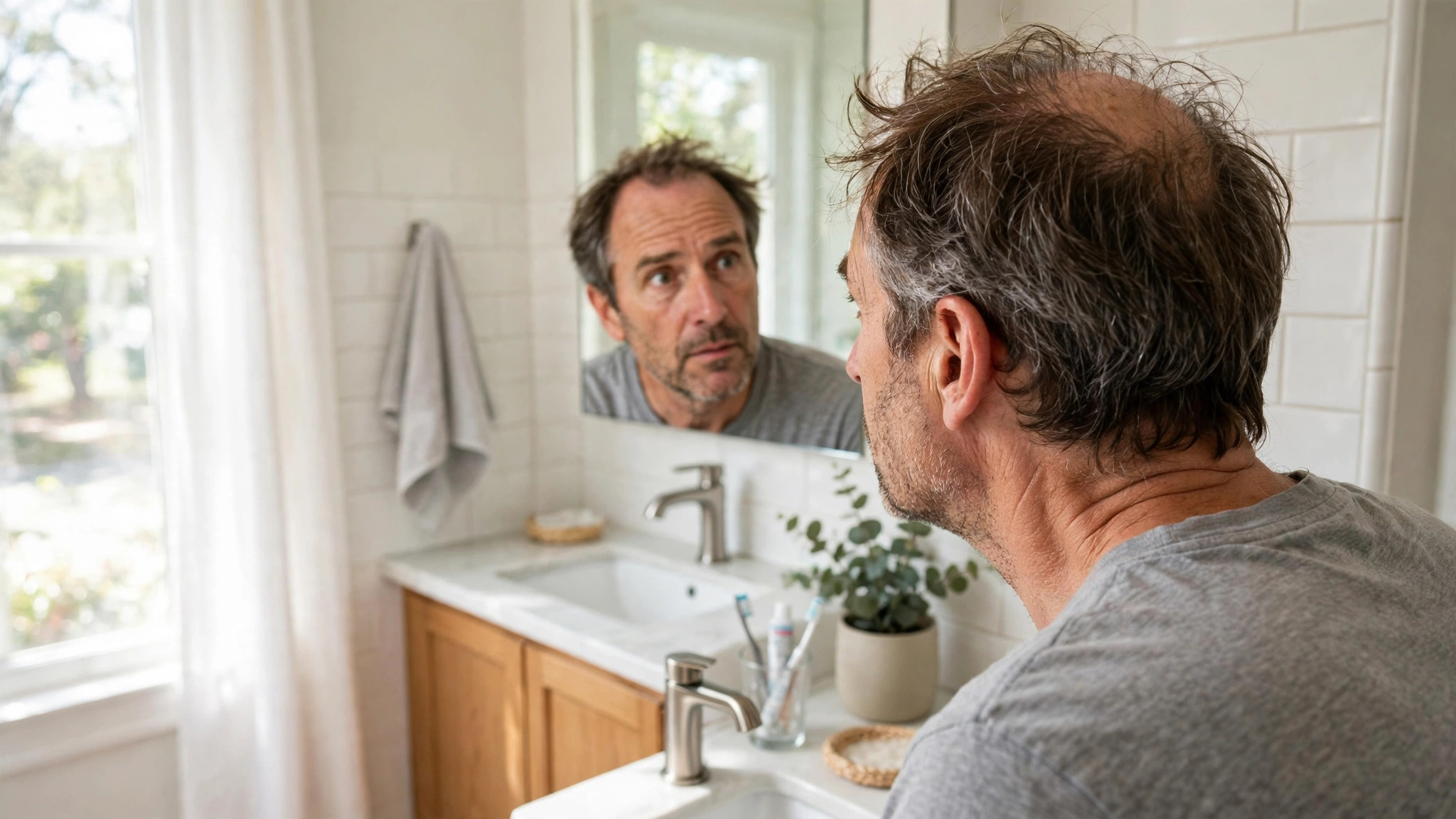
    You notice more hair in the shower. Your hairline is receding. Your part is getting wider.

    You’re in crowded company. According to the American Hair Loss Association, roughly two-thirds of men experience some appreciable hair loss by age 35, and by age 50 about 85% have significantly thinning hair.

    Male pattern baldness isn’t a disease. It’s not a sign of poor health. It’s genetics + hormones + age — a combination most men face at some point. And there ARE things that actually work: not miracle cures, but real, evidence-backed options that can slow the loss, regrow some hair, or help you make peace with what’s happening.

    This guide breaks down what’s causing it and what your realistic options are.

    The Three Requirements for Male Pattern Baldness

    Male pattern baldness (androgenetic alopecia) needs three ingredients:

    1. Genetics (the primary factor)

    If your father or grandfathers went bald, you’re more likely to as well. The genes come from both sides of the family — the androgen receptor gene, one of the key players, sits on the X chromosome, which you inherit from your mother, which is why her side of the family gets so much attention. Genetics influence when loss starts (25 for some men, 60 for others), how fast it progresses, and how much hair is ultimately lost. Having the genes doesn’t guarantee baldness on a schedule — it makes you susceptible.

    2. Androgens (specifically DHT)

    The hormone DHT (dihydrotestosterone) is the trigger. In men whose follicles are genetically sensitive to it, DHT attaches to receptors in the follicle and drives miniaturization — the follicle shrinks, producing thinner hair and eventually none. The confusing part: higher testosterone doesn’t mean more baldness. Some men with low testosterone go bald; some with high testosterone keep their hair. What matters is follicle sensitivity to DHT, and that’s genetic.

    3. Age

    Pattern loss rarely starts before 20, becomes more common through the 30s and 40s, and progresses with time. Age alone doesn’t cause it — not everyone goes bald — but time is a necessary ingredient: the longer sensitive follicles are exposed to DHT, the more miniaturization accumulates.

    Why Hair Loss Accelerates After 40

    Cumulative DHT exposure: 40 years of exposure in a sensitive scalp has taken its toll; miniaturization is well underway.

    A shorter growth cycle: Hair’s growth phase (anagen) shortens with age, so hair spends less time growing and more time resting and shedding.

    Scalp changes: Blood flow and collagen decline with age, creating a less optimal environment for growth.

    The Stages (Norwood Scale)

    Hair loss progresses in a predictable pattern, graded on the Norwood Scale: stages 1–2, minimal temple recession; stage 3, noticeable hairline recession; stages 4–5, significant recession and thinning at the crown; stages 6–7, extensive loss with hair remaining mainly on the sides and back. Key insight: most men stabilize somewhere. You won’t necessarily go completely bald — many men keep the sides and back for life.

    What Actually Works: Proven Treatments

    1. Minoxidil (Rogaine) — over-the-counter

    What it does: Prolongs the growth phase and increases blood flow to follicles; can regrow some hair, best at the crown, less at the hairline.

    Effectiveness: In clinical studies of the 5% solution used twice daily, roughly 40% of men achieved moderate regrowth after a year, and many more slowed or stabilized their loss. It takes 4–6 months of consistent use before you can fairly judge it — and it stops working if you stop using it.

    Cost: Typically ~$20–40/month. Side effects: Usually minimal; occasionally scalp irritation or unwanted facial hair growth.

    Verdict: Works for many men, affordable, no prescription. Worth trying in early stages.

    2. Finasteride (Propecia) — prescription

    What it does: Blocks the enzyme that converts testosterone to DHT, lowering DHT in the scalp — it addresses the mechanism, not just the symptoms.

    Effectiveness: In finasteride’s long-term clinical trials, roughly 9 in 10 men had no further visible hair loss over five years, and around two-thirds saw improved hair counts. Like minoxidil, it works better on the crown than the hairline, takes 3–6 months to judge, and must be continued indefinitely.

    Cost: Typically ~$10–30/month for generic. Side effects: Sexual side effects (decreased libido, erectile difficulties) occurred in about 1–2% of men in trials — close to placebo rates — and usually resolved; a small number of men report effects persisting after stopping, which remains debated. Rarely, breast tenderness or enlargement. Finasteride also shrinks the prostate (it’s used at a higher dose for BPH) and lowers PSA readings — your screening doctor needs to know you take it.

    Verdict: The most effective single option for most men. The side effects are uncommon but real — this is a genuine conversation to have with your doctor, not a checkbox.

    3. Combination therapy (minoxidil + finasteride)

    Using both together is more effective than either alone — minoxidil stimulates growth while finasteride prevents further loss, working on different mechanisms. Typically ~$30–70/month combined, judged over 4–6 months. Best chance of regrowth if you commit long-term.

    4. Hair transplantation

    For advanced loss (stages 5–7), transplants move follicles from the back and sides (which are DHT-resistant) to bald areas. Results are permanent and the transplanted hair keeps growing. Cost typically runs $3,000–$15,000+ depending on extent; allow 6–12 months for full results. Works well for men with enough donor hair — expensive, but a one-time, permanent fix.

    5. Low-level laser therapy (LLLT)

    Caps and devices using red light. Evidence is mixed — some studies show modest benefit, others none — and devices run $200–$3,000+. Unproven; not a first-line choice.

    6. Hair growth shampoos and supplements

    Most commercial “hair growth” products (biotin gummies, DHT-blocking shampoos, saw palmetto) have minimal evidence behind them. Shampoos don’t penetrate deeply enough to matter, and oral supplements show weak results at best — unless you’re correcting an actual deficiency. Won’t hurt, but don’t expect dramatic results.

    Lifestyle Factors That Support Hair Health

    Genetics drives pattern baldness, but lifestyle optimizes whatever hair you keep:

    Sleep: Chronic poor sleep and stress can trigger shedding episodes (a separate mechanism from pattern loss), and neither helps any system involved. Aim for 7–9 hours. See our article on how chronic stress affects your health after 40.

    Exercise: Regular exercise improves circulation and manages stress; ~150 minutes a week of moderate activity is the standard target.

    Nutrition: Hair needs protein, iron, zinc, and B vitamins, and genuine deficiencies can worsen loss. Eat lean protein (our protein guide covers targets), iron-rich foods (red meat, spinach, legumes), zinc sources (oysters, beef, pumpkin seeds), and leafy greens.

    Don’t smoke: Smoking reduces blood flow and increases oxidative stress — both bad for hair, and for everything else.

    What to Expect on Treatment (Typical Course)

    Months 1–3: shedding may temporarily increase — old hairs making way is a known early phase, not failure. Months 3–6: first signs of stabilization; loss slows. Months 6–12: new growth becomes visible, finer at first, then thickening. Month 12+: continued gradual improvement while you stay consistent. This is the typical course reported in the trials, not a promise — individual results vary, and the honest minimum commitment before judging any treatment is about six months.

    Making a Decision: Acceptance vs. Treatment

    Male pattern baldness is NOT a medical emergency, and you don’t “have to” treat it. Consider treatment if the loss genuinely bothers you, you’re in the earlier stages (better results), and you can commit to daily treatment for years with acceptable side effects. Consider acceptance if you’re at peace with your appearance, your loss has stabilized at a look you can live with, or the cost and side effects don’t appeal. Real talk: many men find shaving their head liberating. It’s not a failure — it’s a choice.

    FAQ

    Will hair regrow if I stop treatment? No. Stop minoxidil or finasteride and the loss resumes within months; gains made on treatment are gradually lost.

    Can I prevent baldness if my dad went bald? You can’t fully prevent it if you’re genetically predisposed, but finasteride can substantially slow or delay it. You reduce the rate of loss; you don’t eliminate the predisposition.

    Is male pattern baldness reversible? Partially. Early-stage loss can sometimes be partly reversed with treatment. Long-bald areas — where follicles have been inactive for years — respond poorly.

    Do DHT-blocking shampoos work? Topical shampoos penetrate minimally and rinse off. Oral finasteride works because it reduces DHT systemically. Shampoos alone are unlikely to make a significant difference.

    Is baldness a sign of poor health? No. Pattern baldness is cosmetic, not a health condition, and doesn’t tell you anything reliable about your testosterone, heart, or lifespan.

    The Bottom Line

    Male pattern baldness after 40 is common — by 50, most men are dealing with it to some degree. If it bothers you, real options exist: minoxidil and finasteride have decades of evidence behind them, require commitment (daily use, 6+ months, ongoing cost), and produce real — if modest — results. If you’re at peace with it, that’s equally valid. Either way, baldness is not a reflection of your health, masculinity, or worth. It’s a normal part of aging for many men.